

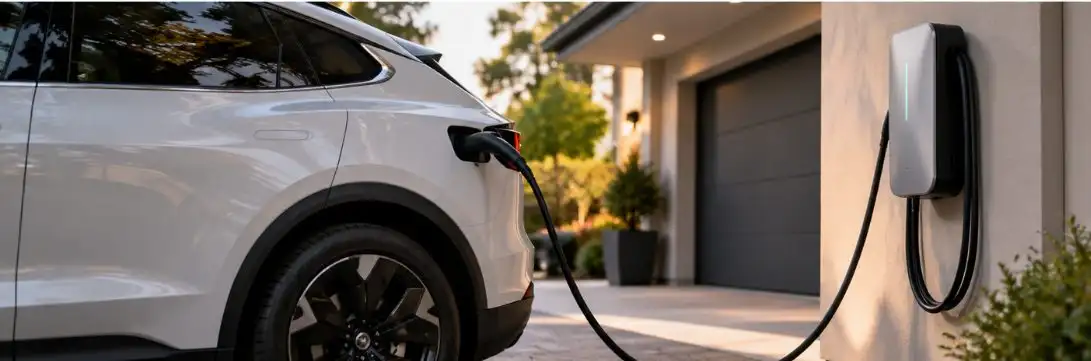
Level 1 vs Level 2 EV Charging at Home
If you drive an electric vehicle, charging happens mostly at home, overnight, while the car sits anyway. The question is how quickly you need to refill and what your house can supply. The two options for home use are called Level 1 and Level 2, and the difference is mostly about voltage.
Here is what each means in miles added per hour, what a proper Level 2 installation involves, and the plug-in versus hardwired choice.
Level 1: the cord that came with the car
Level 1 charging uses a regular 120-volt household outlet and the charging cord that most plug-in vehicles include. It requires no new equipment, which is its appeal. The U.S. Department of Energy’s FuelEconomy.gov puts it at roughly 5 miles of range per hour of charging, which makes it the slowest option.
Think of what that means over a night: roughly a dozen hours plugged in adds somewhere around 60 miles. For someone with a short commute, a plug-in hybrid with a small battery, or a second car that rarely goes far, that can be enough. For anyone driving more, or with a large battery, it quickly falls short.
The Department of Energy notes that Level 1 charging should be on a dedicated branch circuit near where the vehicle parks. A circuit shared with a freezer, a garage door opener and a workshop is not ideal, and a worn outlet or extension cord under a constant load is a heat problem. Do not use an extension cord for EV charging.
Level 2: 240 volts and several times the speed
Level 2 charging uses 240 volts, the same type of supply as an electric dryer or range. FuelEconomy.gov lists an average of about 25 miles of range per hour, with the caveat that speed varies significantly between vehicles, from a few miles per hour up to around 40. A car that needs to recover a typical day’s driving can usually do it in a few hours.
Actual speed depends on two things: how much power the charger and the circuit can deliver, and how much power the vehicle can accept. A vehicle with a modest onboard charger will not charge any quicker just because you installed a bigger unit.
What a Level 2 installation needs
A Level 2 charger is not a plug-in-and-go purchase. It needs a dedicated 240-volt circuit, run from the panel to the place the car parks. Three things decide whether it is simple or complicated.
- Panel capacity and space: the panel must have spare capacity for a large continuous load, plus a free slot for the breaker. A full or undersized panel may call for an upgrade
- Distance and route: the farther the charger is from the panel, the more wire, labor and sometimes conduit through finished walls, an attic or outdoors
- Location: the unit should reach the charge port without stretching the cable across walkways, and outdoor locations need weather-rated equipment
Why the electrical load calculation comes first
The Department of Energy points out that an electrician can tell you whether your home has enough electrical capacity, and recommends a certified electrical contractor for the installation. That is not a formality. A charger can run at its full draw for hours, and the circuit has to be sized with headroom for that. Typical residential Level 2 circuits are commonly in the range of 40 to 60 amps, depending on the charger, but the right number depends on your equipment and your service.
The electrician will look at your service size, what else the panel is feeding, and whether a load management device could let the charger share capacity instead of forcing an upgrade. A permit and inspection are typically part of the process.
Plug-in or hardwired
Many Level 2 chargers can be installed one of two ways. Plug-in units connect to a heavy-duty 240-volt outlet. They are easier to unplug and take along if you move, but they depend on a quality outlet and plug, which can be a failure point under constant load. Hardwired units connect directly to the circuit with no plug in between, which gives a cleaner connection and often allows higher power, and generally is the choice for outdoor mounting.
Neither is universally better. Which is right depends on the specific charger’s instructions, where it will live, and whether you may take it with you someday. Your electrician can recommend one based on your charger and location.
Choosing between the two
If your driving is light and your car sits most of the day, Level 1 may meet your needs. If you drive a lot, charge a bigger battery or want flexibility on busy days, Level 2 is worth planning. Because wiring is the expensive part, it often makes sense to install the circuit now even if you start with the car’s cord, so that upgrading to a charger later is just a matter of mounting it.
A Level 2 circuit is a high-power, continuous load connected to your panel. Do not run an extension cord, use a regular outlet for a Level 2 unit, or open the panel yourself; have the circuit installed and inspected by a licensed electrician.