

How to Choose a Whole-House Generator
People usually start shopping for a generator with a number in mind, a kilowatt rating they saw somewhere. A better starting point is a question: when the power goes out, what do you actually want to keep running, and for how long? Everything else follows from the answer.
This guide walks through the decisions in the order that makes them easier, so you can have an informed conversation with a dealer and an electrician.
Standby versus portable
A portable generator sits in a garage or shed until needed, then gets rolled outside, fueled by hand and connected with cords or through a transfer switch. It costs less up front, but it demands your attention at the worst possible moment, it runs on a limited fuel supply, and it must be operated outdoors at a safe distance from the house.
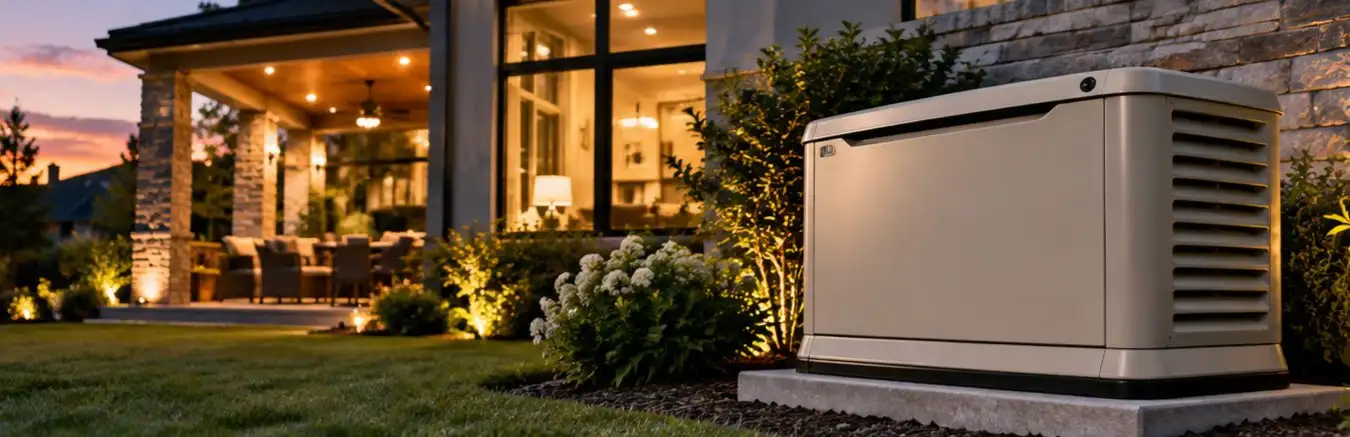
A standby generator is permanently installed outside, connected to a fuel supply and wired into your electrical system through an automatic transfer switch. When utility power fails, it starts on its own, and when power returns, it shuts down. For anyone who is away from home, works nights, or relies on medical equipment, the difference is substantial. For occasional, short outages and a handful of essentials, a portable setup with a proper inlet and transfer arrangement can be a reasonable choice.
Start with the loads, not the model
Sizing is a matter of adding up what the generator will carry. Make two lists. First, what you must have: refrigerator, freezer, a few lights, internet, medical devices, a sump pump, the furnace blower. Second, what you would like: the air conditioner, electric range, dryer, water heater, well pump.
Large motor loads such as air conditioners draw much more when they start than when they run, so they weigh heavily on the size. Generac, which makes the standby systems we install, has a sizing guide and calculator that asks about things like your heating type and whether you charge an EV, and it notes that an authorized dealer is the right person to determine the unit for your home. The goal is a generator with enough capacity for the loads you chose, with headroom, without paying for capacity you will never use.
Whole-house or essential circuits
Backing up the whole house is convenient: nothing to think about, everything works. It generally calls for a larger generator. The alternative is to back up selected circuits only, with a smaller unit and a transfer switch that feeds just those circuits. Load management devices can also let a smaller generator share power among big appliances so they do not all run at once. Both approaches work. Which one fits depends on your priorities and how your household uses power.
Natural gas or propane
Standby generators run on natural gas or propane, and each has trade-offs.
- Natural gas comes through a utility line, so there is no tank to refill and no running out as long as the supply stays on. It requires gas service at the property and a gas line sized for the generator, and supply can be affected in a major event
- Propane is stored in a tank on the property, so it works where there is no natural gas and does not depend on the utility. The tank holds a finite supply, so size and refilling matter during a long outage
- Either way, a gas line connection must be done correctly, and the installation needs to follow code and the manufacturer’s requirements
The transfer switch is not optional
The transfer switch is the piece that safely separates your house from the utility and connects it to the generator. Generac describes it as a required part of a properly installed standby system: it keeps generator power from flowing back onto the utility lines, a danger to line workers, and it lets the generator feed the house safely. The type, size and which circuits it serves depend on how much of the home you back up, your service size and local code. This is wiring work that belongs with a licensed electrician.
Placement and clearances
A standby generator is installed outdoors. Where it goes is dictated by the manufacturer’s installation instructions, local code, and often your gas utility and any HOA rules, because clearances to the house, windows, doors, vents and property lines, and to fuel connections, are specific to the model and jurisdiction. Ask for the manual’s clearance requirements early. Do not assume a spot next to the wall is acceptable, and never place any generator where its exhaust can drift to a window, door or vent. Permits and inspections are typically part of the process.
Maintenance and readiness
A generator you never test is a generator you cannot trust. Standby units usually run a short self-test on a schedule, and they need periodic service: oil and filter, spark plugs, air filter, battery checks, and keeping the surrounding area clear of debris, leaves and vegetation. Follow the maintenance schedule in the owner’s manual. Portable generators need fuel treated or rotated, regular run-ups and fresh oil. An annual service visit is a sensible habit, and a good time to confirm everything still works before storm season.
Connecting a generator to your home’s wiring, the transfer switch, and the gas line are not do-it-yourself tasks. Mistakes can cause fires, damage appliances, or send power back onto utility lines and endanger line workers.